

Dosage & Titration
Individualized dosing with stepwise titration to achieve hematologic control
BESREMI® (ropeginterferon alfa-2b) is supplied as a single-use, pre-filled syringe administered as a subcutaneous injection with individualized dose titration based on patient response and tolerability. Treatment consists of a titration phase followed by maintenance dosing.
BESREMI® offers the potential for reduced dosing frequency
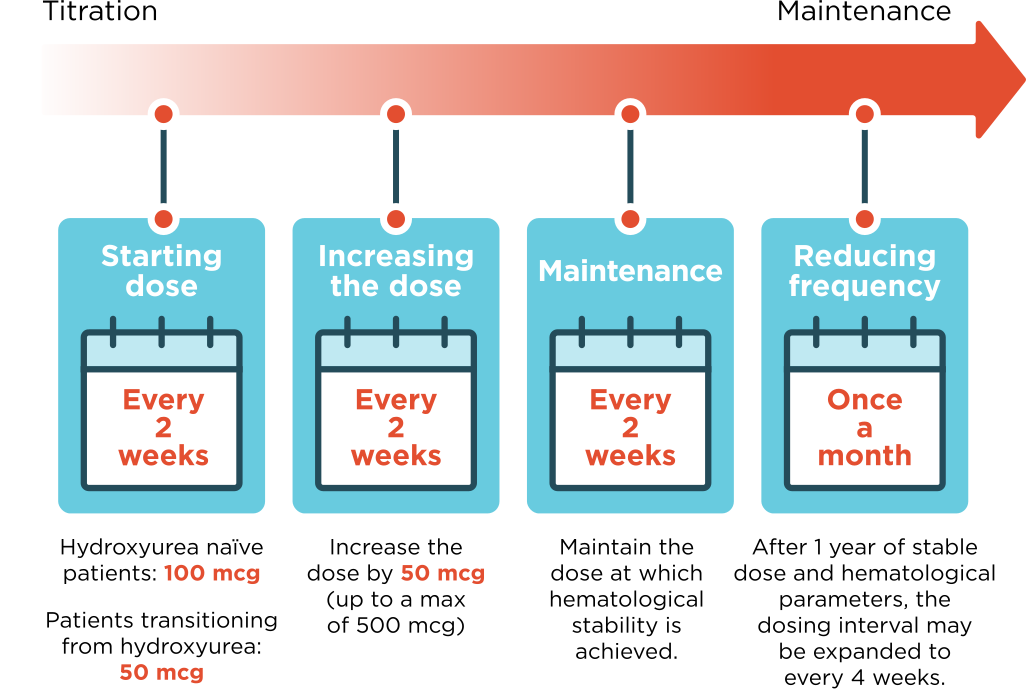
Titration Phase
For patients not already on hydroxyurea
- Start at 100 mcg by subcutaneous injection every 2 weeks and increase the dose by 50 mcg every 2 weeks (up to a maximum of 500 mcg), until the hematological parameters are stabilized (hematocrit less than 45%, leukocytes less than 10 × 10⁹/L, and platelets less than 400 × 10⁹/L).
For patients transitioning from hydroxyurea
- When transitioning to BESREMI® from hydroxyurea, start BESREMI® at 50 mcg by subcutaneous injection every two weeks in combination with hydroxyurea.
- Gradually taper off the hydroxyurea by reducing the total biweekly dose by 20-40% every two weeks during Weeks 3-12.
- Increase the dose of BESREMI® by 50 mcg every two weeks (up to a maximum of 500 mcg), until the hematological parameters are stabilized (hematocrit less than 45%, leukocytes less than 10 × 10⁹/L, and platelets less than 400 × 10⁹/L).
- Discontinue hydroxyurea by Week 13.
Phlebotomy as rescue treatment to normalize blood hyperviscosity may be necessary during the titration or modification phase.
Maintenance
Once hematological parameters are stabilized, the dose at which hematological stability is achieved should be maintained at a two-week administration interval for at least 1 year.
Patients should be closely monitored, in particular, during the titration phase and during dose modification; perform complete blood counts (CBC) regularly, every 2 weeks during the titration and modification phases and every 3-6 months during the maintenance phase (after the patient’s optimal dose is established). Monitor CBC more frequently if clinically indicated.
Reducing the Dosing Interval
After achievement of hematological stability* for at least 1 year on a stable dose of BESREMI®, the dosing interval may be expanded to every 4 weeks.
Stabilized hematological parameters defined
Hematological parameters are stabilized when:


Hematocrit
< 45%

Leukocytes
< 10 × 10⁹/L

Platelets
< 400 × 10⁹/L
Dose Modifications
Modifications in case of adverse reactions
Severity
Dosage Modification
Any increase above baseline
- Interrupt treatment until recovery;
- Restart at a dose 50 mcg lower than the interrupted dose. If the interrupted dose is 50 mcg, refrain from treatment until recovery.
- Consider permanent discontinuation if toxicity persists after four dose-modifications.
Severity
Dosage Modification
> 5 × the upper limit of normal (ULN) but ≤ 20 × ULN
- Decrease dose by 50 mcg;
- If toxicity does not improve, continue decreasing at biweekly intervals until alanine aminotransferase (ALT) and aspartate aminotransferase (AST) recover < 3 × ULN if baseline was normal; 3 × ULN baseline if baseline was abnormal, and gamma-glutamyltransferase (GGT) recovers to < 2.5 × ULN if baseline was normal; 2.5 × ULN baseline if baseline was abnormal.
- If the interrupted dose is 50 mcg, refrain from treatment until recovery.
> 20 × ULN
- Interrupt treatment until ALT and AST recover to < 3 × ULN if baseline was normal; 1.5 × ULN baseline if baseline was abnormal, and GGT recovers to < 2.5 × ULN if baseline was normal; 2 × ULN baseline if baseline was abnormal.
- Consider permanent discontinuation if toxicity persists after four dose-modifications.
Severity
Dosage Modification
Anemia: Hemoglobin (Hgb) < 8 g/dL
Thrombocytopenia: platelet count < 50,000/mm³ but ≥ 25,000/mm³
Leukopenia: white blood cell count (WBC) < 2000/mm³ but ≥ 1,000/mm³
- Decrease dose by 50 mcg;
- If toxicity does not improve, continue decreasing at biweekly intervals until recovery of Hgb > 10.0 g/dL, platelets > 75,000/mm³, and WBC > 3,000/mm³
- If the interrupted dose is 50 mcg, refrain from treatment until recovery.
Anemia: Hemoglobin levels are life threatening, or urgent intervention needed
Thrombocytopenia: platelet count < 25,000/mm³
Leukopenia: WBC < 1000/mm³
- Interrupt treatment until recovery of Hgb > 10.0 g/dL, platelets > 75,000/mm³, and WBC > 3,000/mm³.
- Consider permanent discontinuation if toxicity persists after four dose-modifications.
Severity
Dosage Modification
Mild, without suicidal ideation
Consider psychiatric consultation if persistent (> 8 weeks).
Moderate, without suicidal ideation
Consider dose reduction and psychiatric consultation.
Severe, or any severity with suicidal ideation
Discontinue therapy, recommend psychiatric consultation.
Dose Adjustments for Special Populations
- Renal impairment:
- No adjustment if eGFR ≥ 30 mL/min
- Avoid use if eGFR < 30 mL/min
- Hepatic impairment:
- Monitor liver enzymes and hepatic function
- No BESREMI® dose adjustment is required for adult patients with mild liver impairment.
- BESREMI® is contraindicated in patients with decompensated cirrhosis, including Child-Pugh B or C.
- Discontinue BESREMI® if hepatic decompensation develops during treatment.
- Increased liver enzyme levels have been observed with BESREMI®.
- Reduce the dose if liver enzyme increases are progressive and persistent.
- Discontinue BESREMI® if liver enzyme increases remain progressive and clinically significant despite dose reduction.
- Geriatrics:
- No starting dose adjustment is required for elderly patients
- Pediatrics:
- Safety and efficacy not established
- Hematological stability is defined as hematocrit <45%, leukocytes <10 × 10⁹/L, and platelets <400 × 10⁹/L.